

NFTs and Nirvana
Title is click bait, we are NOT talking about those NFTs. And I also don't talk about Nirvana. But Lithium is involved...

Grandpa Lew … GLEW <3
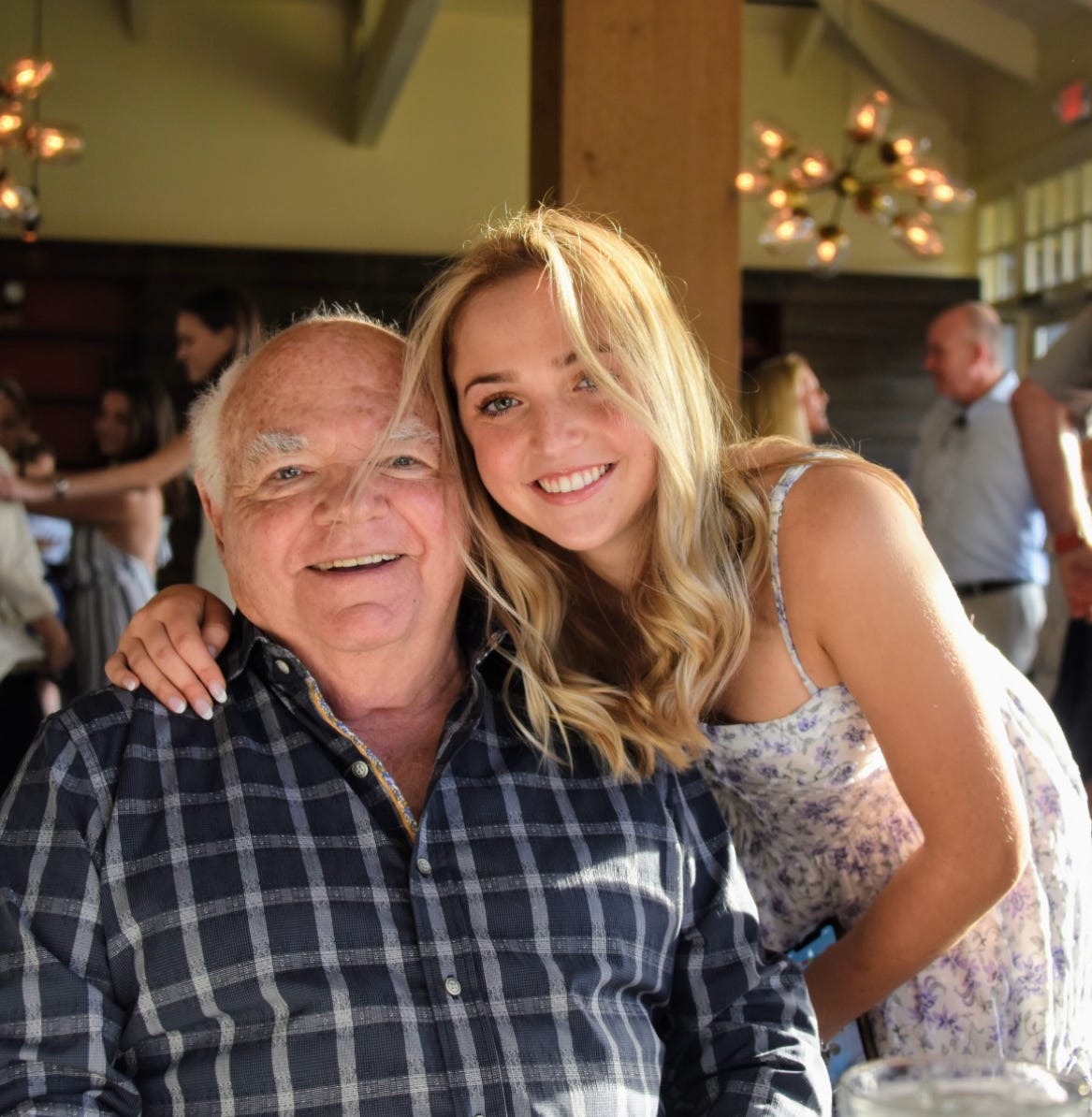
Last summer, my Grandpa passed away. He was diagnosed with Alzheimer’s about 10 years prior. As I get ready to move to Marin to begin my job researching Alzheimer’s Disease, I am thinking a lot about Grandpa Lew.
“I am a mosaic of everyone I’ve ever loved.” - Ranata Suzuki
These are the pieces of my mosaic that came from Grandpa Lew.
My grandpa, Grandpa Lew (aka GLEW), had the best laugh in the entire world. It was distinct and infectious. It could be heard from miles away. And it was unmistakably Grandpa Lew’s. The most obvious piece of Glew in my mosaic is that Lehrman laugh. When someone hears my laugh for the first time, they are shocked and honestly sometimes a bit scared. Almost always, there are follow-up questions like “where did you get that laugh and I fill up with pride and beam as I explain that my grandpa and my dad have the same crazy, ear-splitting laugh, and they should avoid cracking any jokes if they are ever in a room with the three of us. My laugh is one of my favorite things about myself, so thank you, Grandpa Lew, because there is no doubt that came from you.
Similarly, I feel lucky to be goofy just like Grandpa Lew. When my grandpa was in the very late stages of his Alzheimer’s, some of my most meaningful and heart-warming interactions with him were when we’d exchange goofy faces back and forth until ultimately breaking into laughter. Glew showed me the importance of not taking yourself too seriously. I believe this quality allowed him to be the kind, high-spirited, full-of-life person he was, even as his Alzheimer’s progressed.
The Saturday that Grandpa Lew passed, I was in a gas station buying a Gatorade and decided to buy ten 1$ scratch off tickets as I checked out. Of course, I thought of Grandpa as I did this (he was a big gambler, taking my brother, cousins, and me to the horse tracks to bet on a trifecta many weekends). I gave 6 of them to my friends and scratched off 4 myself. None of my friends won anything on their tickets. I won on all 4 of mine. When my Grandma passed away, we would see butterflies everywhere, so I always believe she is with me when I see a butterfly. In that moment, after winning 57$ on scratch-offs, I knew Grandpa Lew was with me. I like to believe in a lot of superstitions and ways of manifesting luck. Instead of letting my Grandpa fuel my gambling addiction from heaven, I think of him when I feel lucky.
Grandpa was always in awe. He was constantly in awe of his life, his family, and just how blessed he was with all of the love and light around him. His home in Florida was alive with bright colors, artwork, and his own photography. ‘Can you believe all this?’ and ‘OOO look at that?’ were some of his go-to expressions as he marveled at the wonders, many of which he created, in his home. When I’d walk through the door and scream ‘GLEWWW’, he’d always express some sort of dumbfounded disbelief and extreme joy that I was his granddaughter. Of course, a lot of this was due to Alzheimer’s, and it was sometimes very sad. Alzheimer’s is very sad. But watching Grandpa Lew struggle through Alzheimer’s was so inspiring. I got to see my grandpa rediscover the abundance of fortune and love in his life. I got to see him choke up, moved by gratitude that he had such a beautiful family, hundreds of times. I hope to take this with me for the rest of my life. I hope to always let myself deeply feel gratitude for my family and marvel in awe at the ordinary, everyday things in my life.
Alzheimer’s Disease
Alzheimer’s Disease (AD) is the most common neurodegenerative disease, meaning neurons die. What even is a neuron, anyway?
What is a NEURON?!
If you think AI and neural networks are cool, you BETTA think neurons are too!
This is a neuron…
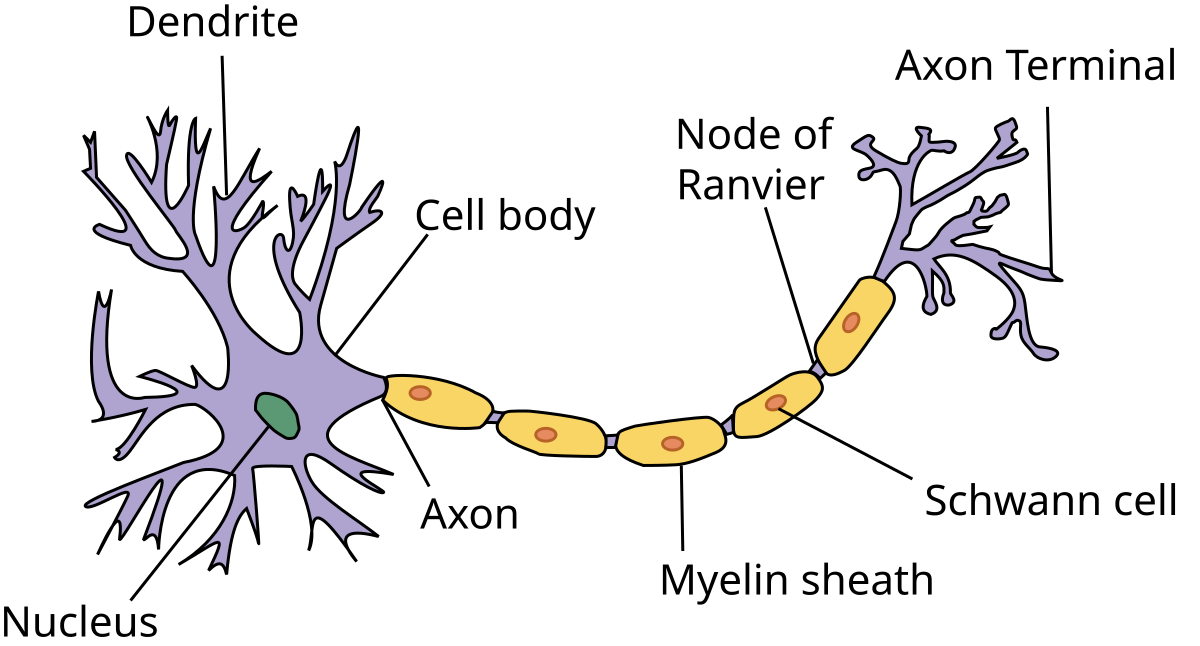
The tree-like structure on the left is the dendrite. The dendrite receives information in the form of chemical signals (neurotransmitters) from other neurons. The cell body contains all of the organelles (for ex: the mitochondria) and integrates the input signals. If a certain threshold is met, the neuron will ‘fire’, meaning it transmits an electrical impulse (called an action potential) down to the other end of the neuron. The middle segment is the axon, which is surrounded by a myelin sheath, which speeds up the travel time for the electrical impulse (think insulation around electrical wire). The gaps (nodes of ranvier) in the myelin sheath allow the electrical impulse to jump from node to node. When this action potential reaches the end of the neuron, the axon terminal, it triggers the release of neurotransmitters (packaged in vesicles) into the synapse, which is the space between neurons.
Plaques and NFTs
NOT NON-FUNGIBLE TOKENS. I DO NOT WANT TO TALK ABOUT PEOPLE PAYING MILLIONS OF DOLLARS FOR A DIGITAL IMAGE OF HOMER SIMPSON. I want to talk about neurofibrillary tangles.
Although AD presents differently between patients, there are two abnormal structures present in all cases. In fact, the presence of both of these structures, amyloid beta plaques and neurofibrillary tangles, is part of the diagnostic criteria.
Amyloid beta plaques: Amyloid beta plaques are sticky, clump-like deposits that form on the outside of neurons (extracellularly). These buildups interfere with normal neuronal functioning. How do they form, you ask… Amyloid precursor protein (APP, the precursor to amyloid beta) is embedded in membranes. Normally, this APP protein gets cut up (cleaved) into smaller fragments that are not problematic. Sometimes, in the case of AD, this APP protein gets cleaved into very problematic and sticky fragments that clump together forming plaques.
Neurofibrillary tangles (aka NFTs or tau tangles): NFTs are aggregates of tau protein. Tau protein normally functions to help stabilize and structurally support the internal ‘skeleton’ of neurons (the cytoskeleton). In AD, tau becomes abnormally modified. A chemical tag, phosphate group, is added to the Tau protein which makes it detach from the cytoskeleton and stick together to other phosphate-tagged Tau proteins. These p-Tau proteins aggregate into NFTs.
Amyloid plaques and NFTs both disrupt neuronal functioning. It’s still unknown exactly how they contribute to disease progression, or how they begin. We don’t know if the formation of these structures is the inciting incident or a further downstream occurence… it’s the classic ‘which came first the chicken or the egg?’
New mind-bogglingly cool paper published in Nature:
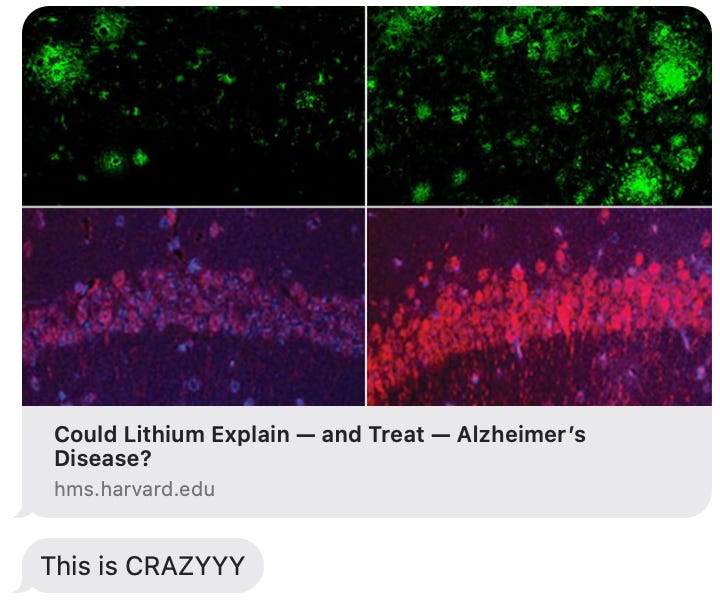
The paper is linked here: Lithium Deficiency and the Onset of Alzheimer’s Disease
You’ve probably (/maybe?) heard of Lithium treatment for people with mood disorders, mainly Bipolar Disorder (BPD).
Dr. Yankner’s research group at Harvard sought out to see if Lithium could be similarly effective for treating Alzheimer’s Disease. People with BPD taking lithium carbonate reportedly had slower cognitive decline AND epidemiology studies from Denmark (S/O their awesome public health system) found that regions with higher Lithium concentration in the water supply had lower rates of dementia. So, he had reason to believe that there might be some protective effect of Lithium in the context of Alzheimer’s/related Dementias.
Step one of their study was to see what metals are present in the brains and blood of people with 1) no cognitive impairment (NCI) 2) mild cognitive impairment (MCI) and 3) Alzheimer’s Disease (AD). They found that Lithium was the only metal that varied between groups, specifically they reported depleted Lithium levels in the MCI group and even further reduced levels in the AD group. They proposed that Lithium is needed by cells for normal functioning and that these amyloid plaques (mentioned earlier as a hallmark of AD) are somehow binding to Lithium and holding it, so it can’t be used by other cells that need it.
The researchers followed with a series of experiments where they looked at the effects of lithium-depletion and lithium treatment on mouse models.
They found that a low-lithium diet accelerated aging (specifically, inflammation), in their wild-type (not AD model) mice and accelerated amyloid plaque and neurofibrillary tangle formation in their AD mouse model.
When they administered lithium orotate (a different Lithium compound than what is used in BPD), this compound is not sequestered (stolen) by the amyloid-plaques. Instead, it is free to be used by other cells that need it, like microglia. Microglia are the brain’s resident immune cells. They clear away debris/cellular waste. When they have their Lithium supply from the lithium orotate, they are able to more successfully clear away the amyloid plaques.
Disruption of lithium homeostasis appears to be an early event in the AD pathogenesis timeline, so hopefully this could be a potential effective AD treatment strategy.
BYE, thank you good people!
favorite one so far💯💯❤️love u Soph